
On this page
Ask a room of operations leaders whether their company uses AI and nearly every hand goes up. Ask whether a core process now runs differently because of it, and most hands come down. That second question is the one that shows up in the numbers.
Key takeaways
- Adoption is broad, but depth is rare: trying tools is not the same as changing how work gets done.
- AI usually stalls on ownership, data and measurement, not on the model.
- Start with one process, one goal and one baseline, and let results decide the next step.
The gap in numbers
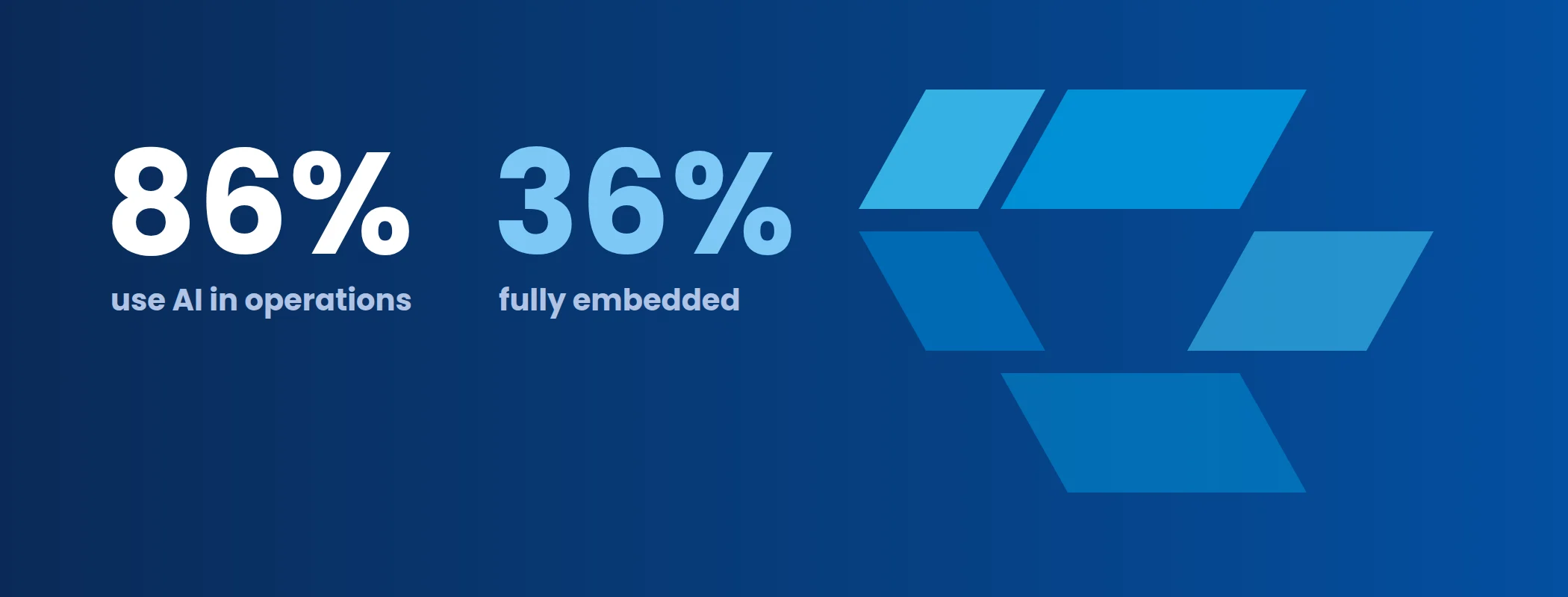
RSM surveyed 1,030 middle market leaders. 86% said they use AI in their operations. Only 36% said it is fully embedded in their core processes. The rest sit somewhere in between: pilots, individual subscriptions, a chatbot on the website.
Smaller companies show the same pattern. Intuit’s AI Impact Report puts regular AI use among US small and midsize businesses at 77%, up from 48% in July 2024. Use is spreading fast. Built-in, measured change is not keeping pace.
Why AI stalls
In our work with mid-sized teams, the model is rarely the problem. The same three things come up again and again.
No one owns the outcome
A tool gets bought, people try it, and nobody is responsible for whether a process actually changes. Without an owner, the pilot quietly becomes a subscription.
The data lives in five places
AI is only as useful as what it can see. When orders, emails and documents sit in separate systems, the AI can draft but not act, and people go back to copying and pasting.
Nothing was measured before
If you don’t know how long a task took last month, you can’t prove AI made it faster. Projects without a baseline lose their budget at the first review.
“Using AI is a purchase. Running on AI is a change in how the work gets done.”
Five steps to close it
This is the method we use with clients. Each step has a clear output and a decision point before the next one.
- Assess. Map the processes, score each opportunity by value and effort, and pick one.
- Prove. Run a small pilot on real work and measure it against the baseline.
- Implement. Build it into the systems people already use, secure and monitored.
- Enable. Train the team so the new way of working sticks without outside help.
- Support. Review results monthly and choose the next process from the roadmap.
Where to start
Pick the process your team complains about most: the one with the most copying, checking and chasing. Write down how long it takes today. That single number is your baseline, and it will tell you, in a few weeks, whether AI earned its place.

AI solutions architect, GDS. CISSP-certified architect for AI, cloud and DevOps. Leads GDS engagements from the first call through support.